
ComSuper pensions: Indexation update
 |
Tim Terrell, PNGAA Representative on ACPSRO
The indexation of Commonwealth pensions paid to retired public servants (including PNG Administration retirees) and military personnel has been a contentious issue for many years.
Successive Federal governments have failed to change from the Consumer Price Index (CPI) as the basis for adjusting these pensions despite the recommendations of three Senate Committees and the fact that the CPI no longer reflects the cost of living: a fact that caused the then Government to adopt a wage-based index for Age Pensions 11 years ago. That change has resulted in the percentage increases in Age Pensions over that period averaging 3% more each year than in Commonwealth pensions. The cumulative effect of this is significant and hardly reflects the "fairness" criterion Labor trumpeted before it took office.
This has been the main issue on which the Australian Council of Public Sector Retiree Organisations (ACPSRO) has focused over recent years. Its efforts, and those of its constituent organizations, (in particular the Superannuated Commonwealth Officers Association [SCOA] and the Defence Force Welfare Association [DFWA]) have had the effect of raising the awareness of Federal politicians and institutions to this issue but until the recent election had produced no policy changes.
The election did, however, bring some positive change. During the election campaign the Coalition announced that it would implement a new indexation system from next year based on the greater of CPI or the wages-based MTAWE index. This was, however, to be confined to Defence Force retirees only. Shortly afterwards, the Greens announced that their policy was to support this improved indexation, and in addition stipulated that it should be applicable to all Commonwealth retirees.
These announcements reflected a significant breakthrough and were welcomed by ACPSRO, although the Coalition policy was seen as being only a step along the way to securing fair indexation for all Commonwealth retirees. The Labor Party, however, remains opposed to any such changes but does accept the recommendation of the 2009 Matthews Enquiry that a new index be developed that better preserves the purchasing power of pensions. So far, nothing appears to have been done to this end.
Throughout the debate about indexation, the issue of the costs associated with changing the system has been a major stumbling block. Official estimates—which are very large—have been based on the "unfunded liability" the proposed change would create. As the "unfunded liability" is calculated over a 40-year time frame, it bears little relation to annual budget costs. For unknown reasons, no official estimates of the budgetary costs have been released. Estimates available to ACPSRO, however, suggest that they are well within the bounds of acceptability, even under current budgetary constraints, and would be negligible if funded through the Future Fund and offset by inevitable clawback.
Where we go to next on this issue is difficult to foresee at this stage. The current political situation in the Federal Parliament creates unusual difficulties but also opportunities. Getting greater clarity on the budgetary implications of the change is clearly a priority, and will be pursued, as will soundings of parliamentarians who are known to be sympathetic to our cause. Broadening understanding of the issue in the community and among present and future retirees is also important. To this end a chart giving examples of how much individual retirees are falling behind under the present indexation regime is reproduced below. It remains important to convince more parliamentarians of the need to achieve greater fairness in the indexation of pensions of Commonwealth retirees by supporting the change from CPI indexation to wages-based indexation such as applies to Age Pensions.
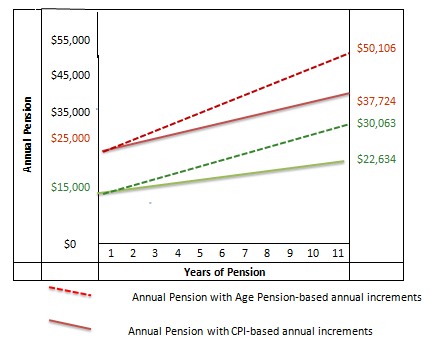
Notes:
- The average ComSuper/Military pension as at 30/6/2009 was $24,700.
- Annual changes are based on the average annual percentage increases of ComSuper/Military and Age Pensions as published by SCOA in its chart titled "Comparison of the Cumulative % Increase of Age Pensions, ComSuper Pensions and MPs' Pensions".
- "Years of Pension" are based on the data contained in the SCOA chart for the period 31/12/1998 to 31/8/2009.
- Largely based on MTAWE indexation, Age Pensions have increased by an average of about 3% pa more over the period than the CPI-based ComSuper/Military Pensions.