
PNGAA Library
Matti: Judi Davis

Dr Marion Aroha Radcliffe-Taylor (Matti) MB, ChB, FRCS (Edinburgh) (circa 1891 – 1976)
Compiled and written by Judi Davis (née Washington) 2013
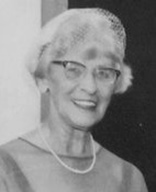
Matti at a wedding in Australia in 1962
Dr Marion Aroha Radcliffe-Taylor, or Matti as she was affectionately called, was a colourful Rabaul identity, respected doctor and talented artist. She was originally from Dunedin in New Zealand. Born in the 1890s, published birth dates vary from 1891 to 6 August 1898. I believe that her middle name “Aroha” means “love” in the Maori tongue. Her mother’s name was Mary and her father, Richard Radcliffe Taylor originally from Preston in Lancashire, England, was founder of the Zealander Waterproof Company in New Zealand. Matti was a GP in Rabaul and people said that with her experience she could do almost anything. Many of the Rabaul resident’s babies came into the world delivered in her capable hands. However, before going to Rabaul in the late 1950s, Matti was an Orthopaedic Surgeon in Western Australia. She was Honorary Assistant Orthopaedic Surgeon at the Fremantle Public Hospital from 1932 to 1933, and Honorary Orthopaedic Surgeon there from 1932 to 1947.
Previously Matti had trained as an Orthopaedic Surgeon at Otago University, New Zealand and Edinburgh University, and had extensive experience in her speciality of Orthopaedic and Industrial Surgery.
Many considered her to be a trail blazing woman in her field, and she was listed in the Encyclopaedia of Australian Science, and Who’s Who in Australia 1921-1950.
Matti was highly trained and respected, but controversy erupted in the WA Parliament when she was appointed State Insurance Doctor of WA in 1938. Complaints were made that, even though she was extremely qualified, almost too much for the job, the appointment should have been given to a man!
During World War II, Matti was listed as Captain of the Australian Forces Active List from 1940 to 1943. Her Service Number was W56564 and she enlisted in Perth.
Interestingly too, in the late 1930s she was involved in tin mining in WA and a hobby that she listed at the time was yachting.
In 1945 Matti married Charles Ray Grant-Frost (Ray), who was prominent wheat and sheep farmer from Deep Pool, Beverley, WA. She then set up private GP practices in Beverley (150 km from Perth) and nearby Brookton. Here she also delivered many babies as part of her practice.
At the end of 1949, the Beverley property was sold and another property was acquired at Boyup Brook. Matti temporarily retired from medical practice to become a farmer with her husband.
Ray and Matti married late in life and had no children of their own, but adopted two European refugee children, Helge and Dieter, after the war. The children’s stepfather had been a respected artist in Latvia, a fact which came to Matti’s attention. The extended family was assigned to the Grant-Frosts as farm workers after they arrived in Freemantle in 1949. This led to the two boys being adopted by Matti and Ray.
Matti cared for a niece, Trudy, for whom she was the only relative. Trudy had Muscular Dystrophy for which there was no treatment, and Matti contacted people all over the world trying to find a cure for her condition.
In the late 1950s Matti went to Rabaul as a GP after the family experienced severe financial stress at Boyup Brook. In the early 1950s Australia was said to be “riding on the sheep’s back”. However there was considerable farming hardship when the value of the woolclip plummeted overnight following the announcement of the Korean War ceasefire. Most tragic of all was the fact that a bushfire gutted the entire Boyup Property, and restocking at record high prices left the family in desperate financial straits.
It was decided that Matti needed to return to medical practice. At the time the Australian Government had a policy of attracting skilled people to PNG by not taxing their income. So it was Rabaul’s gain that Matti went there from WA. Unfortunately, despite her valiant efforts to save the Boyup Brook property, it was not to be, and it was eventually sold to a neighbour.
Matti’s interest in art obviously began early in her life. There is an engraving of a Victorian Gothic building, signed by her in 1923, held in Professor Alexandra Murray Drennan’s collection at the LHSA in the UK. The Professor was Chair of Pathology at Otago University in New Zealand, 1914-1928.
Matti had been heavily involved in the art scene in Perth. Together with prominent modern artist Elise Blumann, who was recognised later in her life, she held exhibitions of sculptures in the form of modelled heads. Her friend Elise trained in Europe and is represented in many galleries including the National Gallery of Australia in Canberra. Elise and Matti also travelled into the outback of WA where Elise painted aborigines going about their daily lives.
Although a self-taught artist, Matti’s work was well received by the Perth press. The West Australian newspaper stated that she showed great ability in delineating the character of her models, and her modelled heads showed clever handling and great depth of feeling. She also listed etching as a hobby.
In Rabaul, Matti helped establish the Rabaul Art Society and invited many prominent Australian artists to judge the competitions. As well as carrying on her medical practice, she continued with her own artwork and painted at her art studio in Rabaul.
In addition, Matti was interested in local Tolai art. She discovered important primitive sculptures near Kabaira plantation and donated two pieces to the British Museum.
She was well travelled. Among other places, in later years Matti visited Mexico, which she loved, and was influenced by Mexican art and culture.
Matti retired to Caloundra on the Sunshine Coast of Queensland in 1974.
On 11 March 1976, whilst visiting Sydney, she suffered a heart attack and died suddenly. Her body was returned to Brisbane and she was cremated at the Albany Creek Crematorium.
As an elderly doctor in Rabaul, Matti was a larger than life ‘character’, and a friend of my mother Dorothy Washington of Kabaira Plantation. I feel very privileged to have known her. She was a remarkably talented person who lived a full, varied, interesting and compassionate life. In her time she played an important role in Rabaul’s medical and cultural life.
Matti is and was remembered with affection and gratitude by many people in many places.
Additional information: Helge Grant-Frost
www.http://trove.nla.gov.au
www.ancestry.com.au
http://recordsearch.naa.gov.au
http://nzetc.victoria.ac.nz (for info on Zealandia Waterproof Company)
www.lhsa.lib.ed.ac.uk (LHSA - University of Edinburgh Lothian Health Services Archive)
Elise Blumann: Paintings & Drawings 1918–1984
N.S.W Register of Deaths: Marion Aroha Grant-Frost (known as Marion Aroha Radcliffe-Taylor)
Alex Gow Funeral Directors, Brisbane, Qld
Sydney Morning Herald
Encyclopedia of Australian Science
Who’s Who in Australia, 1921-1950
Pacific Islands Monthly, May 1976